System Design From Scratch — Floor 4: When One Machine Isn't Enough
Fifth post in the series. We can store data durably on one machine. But one machine is a single point of failure, and it has a capacity ceiling. This floor goes wide — and it's the floor the whole distributed world stands on.

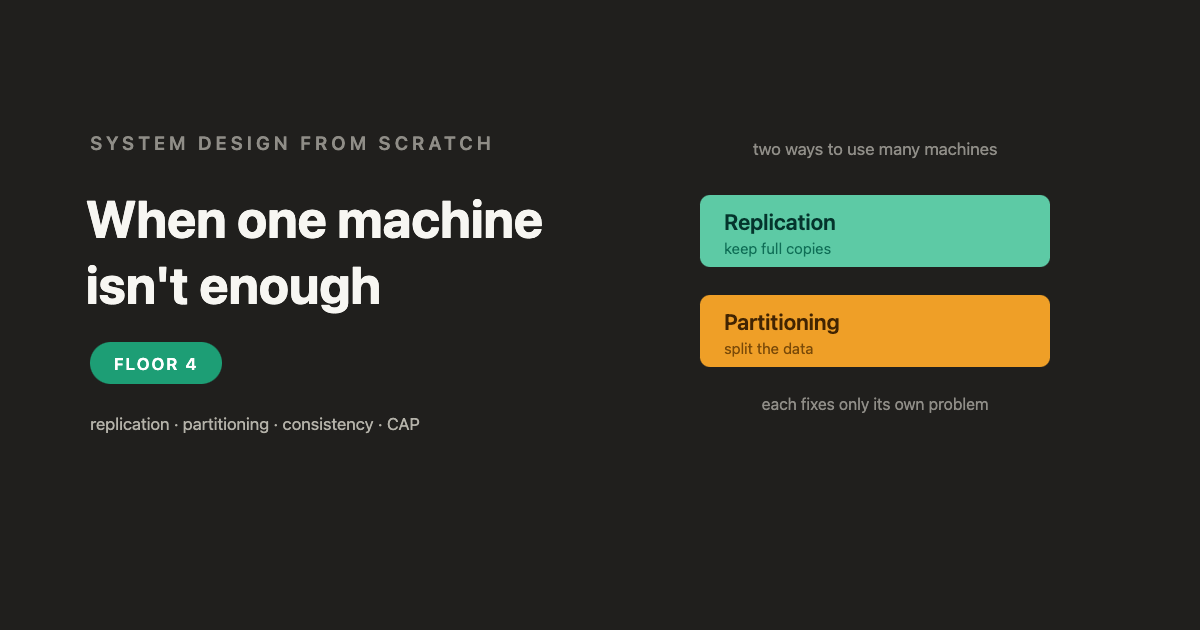
Two problems with one machine
Put your whole app's data on one database machine. As you grow, it fails you in two distinct ways:
- Fault tolerance — it's a single point of failure. Disk dies, power dies, machine dies → your data's gone and your service is down.
- Scalability — one machine has a hard capacity ceiling (RAM, disk, CPU). Grow past it and you're out of room or crawling.
Different problems — and they have two different fixes. Mixing them up is a classic mistake.
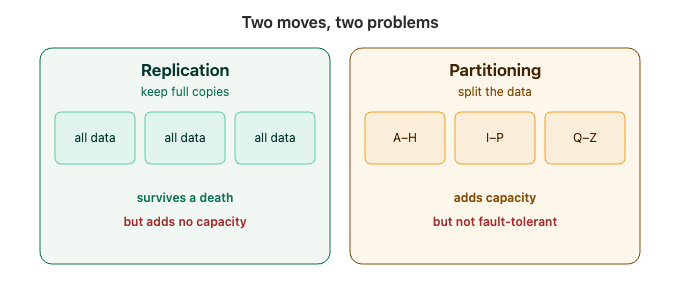
- Replication = keep full copies of the data on multiple machines. Fixes fault tolerance (and read scaling). But every machine still holds everything, so it adds no capacity.
- Partitioning (sharding) = split the data into slices, each machine holding a different one. Fixes capacity (and write scaling). But each slice still lives on one machine, so it's not fault-tolerant.
Each fixes only its own problem. So real systems do both: partition to spread the load, then replicate each partition so no slice has a single point of failure.
Replication's price: consistency
The moment you keep 3 copies and someone changes the data, a new problem appears: the copies can disagree. User updates their email; the leader and one replica have the new value, but a lagging replica still serves the old one. A read that lands there gets stale data. That's consistency — do the copies agree? — and it's Floor 0's cache-staleness problem wearing a replication costume.
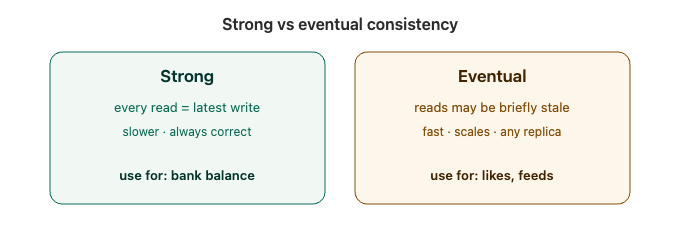
- Strong consistency — every read sees the latest write (read the leader, or wait for replicas to sync). Correct, but slower.
- Eventual consistency — reads may be briefly stale, but any replica can answer, fast and scalable. Copies converge "eventually."
The decision rule: the cost of being briefly wrong picks the side. A stale like-count is free; a stale bank balance is a lawsuit.
Partitioning's price: routing and hotspots
Split your data across machines and you now must answer: which machine holds Alice? You route by a partition key — hash(user_id) → a shard — using consistent hashing so that adding a machine moves only ~1/N of the keys, not everything.
The nastier trap is a hot partition (data skew, the "celebrity problem"): if one key gets a huge share of the traffic, its shard melts while the others idle — defeating the whole point. The fix is in the key choice (pick a high-cardinality key that spreads evenly), and for a single hot key, salting (append a suffix to fan it across sub-shards).
The capstone: CAP
Now combine replication (copies on machines A and B) with Floor 2's lesson (the network is unreliable — sometimes machines can't talk). The link between A and B breaks. A write arrives at B, which can't reach A. It has exactly two options, both bad:
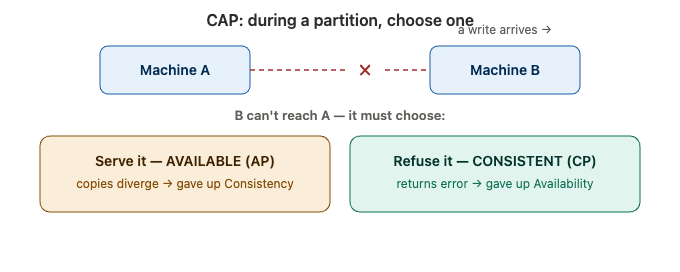
- Serve it → Available (AP): the customer gets an answer, but B's data now diverges from A. You gave up Consistency.
- Refuse it → Consistent (CP): the data stays correct, but the customer gets an error. You gave up Availability.
There's no third option — B physically cannot coordinate with A. That's the CAP theorem: when a network Partition happens, you must choose C or A.
- AP fits a shopping cart or feed (Amazon's cart is always writable, and merges conflicts later). Downtime costs more than a little divergence.
- CP fits a bank transfer — better an error than a double-spend.
The nuance most people botch: CAP only forces the choice during a partition. When the network is healthy, you get both. It's "when the network splits, which do you sacrifice."
What you now own
- two problems — fault tolerance + scalability → two moves — replication + partitioning (each fixes only its own → do both)
- replication's price: consistency (strong vs eventual, chosen by the cost of being wrong)
- partitioning's prices: routing (consistent hashing), rebalancing, hot partitions (fix via key choice + salting)
- the capstone: CAP — during a partition, choose C or A (AP = stay up, reconcile; CP = refuse rather than diverge)
Next: Floor 5
We've built the whole stack, bottom to top. Floor 5 is the meta-floor: the everyday patterns engineers assemble from these blocks — load balancers, stateless services, message queues — and the one tension that runs through every single floor.
See you on Floor 5.